
Weekly Reflection 7- Computational Thinking and Gaming in Education

At first, the idea of coding in the classroom felt somewhat intimidating. I had never created a digital tool before, and my initial question was simple: what exactly is computational thinking, and how could it realistically connect to the subjects I plan to teach?
I am familiar with the ideas of decomposition, pattern recognition, abstraction, and algorithms. I think these are valuable techniques and skills to teach students, especially those who become overwhelmed by complex instructions. I know this feeling well myself. When instructions feel too large or confusing, I often need someone to break them down for me. At the same time, I notice that I can do this for others when the subject is something I understand well. That realization made me appreciate how important these problem-solving approaches are for learners.
Before this week, I always thought coding was something only computer engineers, hackers, or very technical people did. What surprised me was learning how accessible it can be. There are websites that provide ready-made coding examples, and even AI tools can generate code that teachers can adapt. I was also surprised by how simple it is to run a small program by saving it as an HTML file and opening it in a browser.
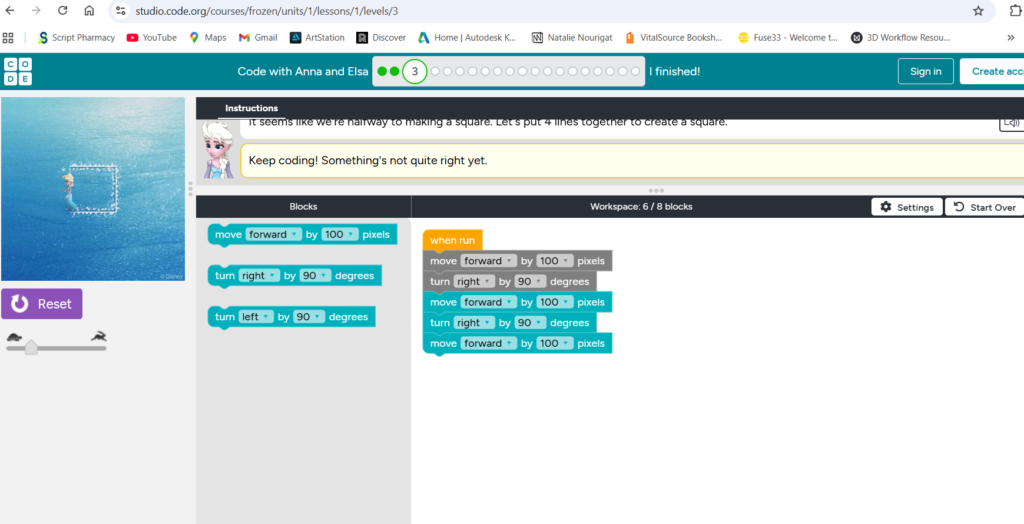
I briefly explored Studio Code and also tried the “Code with Anna and Elsa” activity. I found it very intuitive and engaging. Activities like this invite students to think about how instructions work and how commands are organized. For students who struggle with long written instructions, this approach may help them see that a large task is often just a sequence of smaller steps placed together. In many ways, a long paragraph of instructions can be understood as a series of smaller “codes” that can be decomposed and solved step by step.
One example that I didn’t connect well with was “Bad News” game, which teaches media literacy by placing players in the role of someone creating misinformation. By simulating how fake news spreads, the game exposes the techniques behind manipulation and encourages players to critically evaluate information sources. While I appreciate the intention of educating students about how to critically read the news, my own reaction to the game was complicated. Even with the short time I spent exploring the website, I found it emotionally difficult. Knowing that members of my immediate family are currently experiencing an unjust and unlawful war, and that much of the public receives information from media sources that may not always be fact-based, the topic felt heavy and stressful. It reminded me that when using games in education, teachers must be thoughtful about the emotional context students bring with them. What may be intellectually engaging for some learners may feel overwhelming for others.
As I thought about how coding might connect to the subject I will be teaching, physics, I began asking myself what kind of tool could help students better understand core concepts. Motion often becomes abstract for students when they only see formulas written on paper. After experimenting with some simple coding tools, I decided to try creating a small interactive simulation where students can explore the relationship between speed, distance, and time.
The idea behind the tool is straightforward. Students can enter different values for speed, distance, or time and observe how the motion changes. For example, they can set a distance and see how long it takes a car to reach that point at different speeds. Alternatively, they can set speed and time and see how far the car travels. Watching the car move across the screen provides a visual representation of the equation: distance = speed x time, helping students connect mathematical relationships to physical motion.
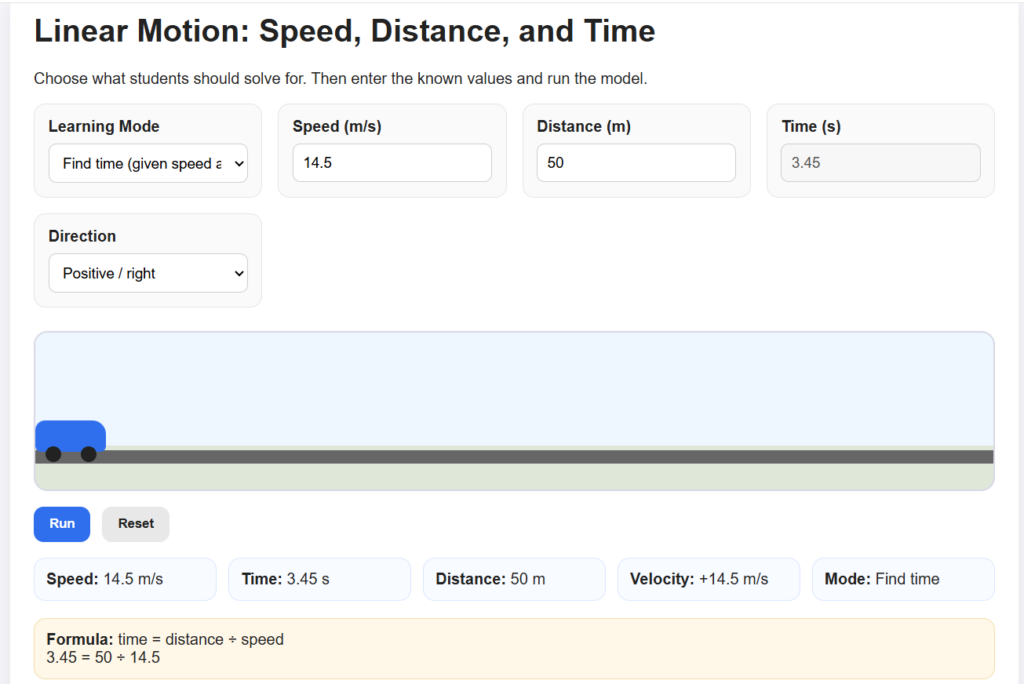
Building this simple simulation helped me appreciate how coding can support inquiry-based learning. Instead of simply solving equations, students can test ideas, change variables, and observe patterns. In this sense, the coding activity becomes a form of computational thinking in action: students manipulate variables, observe outcomes, and develop conceptual understanding through exploration.
At the same time, our discussions about gaming in education reminded me that games must be used thoughtfully. While games can increase engagement and motivation, they are not automatically meaningful learning experiences. The design of the activity matters. A well-designed learning game should encourage exploration, problem solving, and reflection rather than simply reward speed or competition.
Overall, this week changed how I think about coding and games in education. Rather than viewing them as separate from traditional teaching. Moving forward, I hope to continue experimenting with small simulations and interactive tools that allow physics students to explore concepts rather than only calculate them. At the same time, I still hope that board games, hands-on activities, and outdoor learning will remain an important part of the classroom experience.